PR2 (ProN)
Legacy device
ProN (PR2) is no longer in production. This page and its specification download remain available for existing devices. For the newer generation, use the Pro3 (PR3) page.
Choose your Pro generation
The Pro family includes different hardware generations. The specifications and images on this page are for ProN (PR2), device ID prefix 20.
| Your device | Where to start |
|---|---|
| ProN / Pro PR2 | Continue on this page. This model has four battery indicators and two separate GPS/mobile-network indicators. |
| Pro3 / PR3 | Use the Pro3 device page. This model has four power indicators and different electronics. |
If you are unsure which model you have, check its product code or ask support with the device ID. Do not choose a guide from the name “Pro” alone.
Feature guides
Selected shared features, with more guides to come. This is not a complete feature list.
Use the LED guide to interpret a pattern in context. The PR2 startup example is below.
Images


Overview
Our most rugged and long-life tracker for harsh environments.
| Name | ProN (PR2) |
|---|---|
| Version | 2 |
| SKU | PR2 |
| Serial prefix | 20 |
| Connectivity | cellular, bluetooth-le |
| Positioning | gnss, wifi |
| Sensors | accelerometer, temperature |
Physical
| Size | |
|---|---|
| Dimensions Mm | 85 x 44 x 28.4 |
| Weight G | 150 |
| Certifications | |
| 0 | CE |
| Rating | |
| Ip | IP66 |
| Operating Temperature C | -20 to +60 |
Integrations
| Cloud | |
|---|---|
| Supported Platforms | Lightbug Cloud (Hosted or On-premise), Other clouds supported via Forwarding |
| Native Protocols | UDP, TCP |
| Forwarding Protocols | MQTT, HTTP(S), WebSocket |
User Interface
| Buttons | |
|---|---|
| Multi Purpose | Status Check, Trigger Update, Software Reset, Hardware Reset |
| Leds | |
| Battery | 4 battery-level indicators, Show approximate charge level and charging progress |
| GPS And Mobile Network | 2 diagnostic status indicators, Diagnostic status; see the LED guide for restart and normal patterns |
Connectivity
| Cellular | |
|---|---|
| Technologies | LTE CAT-M1, GPRS, EDGE |
| Territory | Global |
| Bands | LTE FDD: B1, B2, B3, B4, B5, B8, B12, B13, B18, B19, B20, B26, B28 LTE TDD: B39 Gsm: 850MHz, 900MHz, 1800MHz, 1900MHz |
| Bluetooth LE | |
| Technologies | Low Power Broadcasting (iBeacon), Gateway Scanning, Child (peripheral) device |
| Territory | Global |
| Version | 5.4 |
Positioning
| Gnss | |
|---|---|
| Typical Accuracy Meters | 1-5 |
| Technologies | GPS, GLONASS, BeiDou |
| Constellations | GPS: Bands: L1: 1575.42 GLONASS: Bands: L1: 1602 + n x 0.5625 (n=-7,...6) BeiDou: Bands: L1: 1575.42 |
| Wifi | |
| Typical Accuracy Meters | 10-30 |
| Technologies | 2.4Ghz Wi-Fi AP scanning |
Sensors
| Accelerometer | |
|---|---|
| Typical Accuracy G | 0.01 |
| Features | 3-axis accelerometer, Motion Detection, Orientation & Tilt detection, Shock and Vibration detection |
| Temperature | |
| Typical Accuracy C | 5 |
| Features | Temperature Sensing (low accuracy), Thermal Protection |
Battery
| Overall | |
|---|---|
| Capacity mAh | 6600 |
| Pack Configuration | 1S2P |
| Voltage V | 3.7 |
| Cells | |
| Type | 18650 |
| Spec | Model: 18650 3300mAh Type: Li-ion Cell Nominal Voltage V: 3.7 Nominal Capacity mAh: 3300 Nominal Energy Wh: 12.21 Physical Dimensions Mm: Φ 65.0*18.0 Appearance: Blue cylindrical battery Certifications And Tests: Standard: UN38.3 (UNITED NATIONS 'Recommendations on the TRANSPORT OF DANGEROUS GOODS' Manual of Tests and Criteria ST/SG/AC.10/11/Rev.6, 38.3) Tests: Altitude Simulation: No leakage, no venting, no disassembly, no rupture & no fire Thermal Test: No leakage, no venting, no disassembly, no rupture & no fire Vibration: No leakage, no venting, no disassembly, no rupture & no fire Shock: Included as a test item in the UN38.3 report External Short Circuit: No disassembly, no rupture & no fire (Max external temperature: 66.4 ~ 78.8°C) Impact: No disassembly & no fire (Max external temperature: 106.9 ~ 129.2°C) Forced Discharge: No disassembly & no fire |
Charging
| Inputs | |
|---|---|
| Voltage Range V | 5-14 |
| Current Limit A | 0.1 to 3.25 |
| Features | |
| Fast Charge | 5-14V input with Fast Charge support |
| Configurable | Configurable draw and charge rates |
Components
| Cellular | |
|---|---|
| Manufacturer | SIMCom Wireless Solutions Limited |
| Model | SIM7000G |
| Specifications | Supported Technologies: LTE CAT-M1, LTE NB-IoT, GPRS, EDGE Frequency Bands: Gsm: Bands: 850/900/1800/1900MHz Egsm 900mhz: Transmit Frequency Mhz: 880-915 Receive Frequency Mhz: 925-960 Dcs 1800mhz: Transmit Frequency Mhz: 1710-1785 Receive Frequency Mhz: 1805-1880 Lte Cat M1: Bands: B1/B2/B3/B4/B5/B8/B12/B13/B18/B19/B20/B26/B28/B39 Lte Nb Iot: Bands: B1/B2/B3/B5/B8/B12/B13/B17/B18/B19/B20/B26/B28 Data Transfer Rates Kbps: Cat M Dl: 300 Cat M Ul: 375 Cat Nb Dl: 34 Cat Nb Ul: 66 Egprs Dl: 85.6 Egprs Ul: 85.6 Edge Dl Ul: 236.8 Gprs Dl Ul: 85.6 Supply Voltage Range V: 3.0 ~ 4.3 Power Consumption Typical: Power Off Ua: 7 Psm Ua: 9 Sleep Ma: 1 Idle Ma: 11 Temperature Range C: -40 ~ +85 Certifications: FCC, IC, CE, 3C, GCF, RoHS, REACH, RCM, PTCRB |
| Bluetooth LE | |
| Manufacturer | STMicroelectronics |
| Model | STM32WB55xx |
| Specifications | Chip Type: Multiprotocol wireless 32-bit MCU Arm®-based Cortex®-M4 with FPU Radio Features: Frequency: 2.4 GHz Bluetooth Specification: 5.4 Ieee 802 15 4 Support: Yes (supports PHY and MAC, supporting Thread 1.3 and Zigbee® 3.0) Rx Sensitivity Dbm: Bluetooth LE 1mbps: -96 Ieee 802 15 4: -100 Programmable Output Power Dbm: +6 (with 1 dB steps) Integrated Balun: Yes Data Rates Mbps: 1, 2 Dedicated Radio Cpu: Arm® 32-bit Cortex® M0+ External Pa Support: Yes Memory: Flash Memory Size: Up to 1 Mbyte Sram Size: Up to 256 Kbytes (includes 64 K SRAM1 and 64 K SRAM2 for STM32WB55Cx models) Operating Voltage V: 1.71 to 3.6 Operating Temperature C: -40 to +85 and -40 to +105 (Ambient) Power Consumption Typical Ma At 3 3v: Tx Max Output Bluetooth LE: 7.8 Tx Max Output 802 15 4: 6.5 Rx Bluetooth LE: 4.5 Rx 802 15 4: 4.5 Run Mode Flash 64mhz Typical Ma: 8.8 |
| Gnss | |
| Model | SIM7000G |
| Specifications | Gnss Systems: GPS, BeiDou, GLONASS Receiver Type: Channels: 16-channel Code: C/A Code Sensitivity: Tracking: GPS: -162 dBm GLONASS: -157 dBm BeiDou: unknown Cold Starts: -148 dBm Time To First Fix: Cold Starts: <35s Hot Starts: <1s Accuracy: Position: <2.5m CEP |
| Wifi | |
| Manufacturer | Espressif Systems |
| Model | ESP8285 |
| Specifications | Soc Description: Highly integrated Wi-Fi SoC solution for IoT industry (can perform as a standalone application or as the slave to a host MCU) Recommended Upgrade: ESP8684 Wi Fi Protocols: 802.11 b/g/n (HT20) Wi Fi Frequency Range Mhz: 2400 ~ 2483.5 Tx Power Dbm: 802 11b: +19 802 11g 6mbps: +19 802 11g 54mbps: +15 802 11n Mcs0: +19 802 11n Mcs7: +14 Rx Sensitivity Dbm: 802 11b 1mbps: -97 802 11g 54mbps: -74 802 11n Mcs7: -70 Cpu: Tensilica L106 32-bit processor (up to 160 MHz) Memory: 1 MB Operating Voltage V: 2.7 ~ 3.6 Crystal Frequency Range Mhz: 24 ~ 52 Power Consumption Deep Sleep Ua: 20 Power Consumption Active Ma: Average: 80 Tx 802 11b 19dbm: 197 Rx 802 11b: 73 Modem Sleep Typical: ~15 (DTIM3, 300ms sleep/3ms wakeup) Light Sleep Typical: ~0.9 (DTIM3, 300ms sleep/3ms wakeup) |
| Accelerometer | |
| Manufacturer | STMicroelectronics |
| Model | LIS3DHTR |
| Specifications | Device Type: MEMS digital output motion sensor: ultra-low-power high-performance 3-axis 'nano' accelerometer Data Output: 16-bit Full Scale Range: ±2g/±4g/±8g/±16g (dynamically selectable) Supply Voltage V: 1.71 to 3.6 Operating Temperature C: -40 to +85 Power Consumption Ulp Ua: down to 2 (normal mode at 1 Hz ODR) |
| Charger | |
| Manufacturer | Texas Instruments |
| Model | BQ25890H |
| Specifications | Description: I2C Controlled Single Cell 5-A Fast Charger with MaxChargeTM Technology Charge Current A: 5 (Fast charge current, adjustable from 128mA to 5056mA) Charge Efficiency Percent: At 2a: 93 At 3a: 91 Usb Otg Output V: 4.5 to 5.5 (adjustable) Usb Otg Output Current A: 2.4 Boost Efficiency Percent: 93 (at 5V, 1A output) Input Voltage Range V: 3.9 to 14 Input Current Limit A: 0.1 to 3.25 (50-mA resolution, automatically set by source detection) Battery Discharge Mosfet Resistance Mohm: 11 Battery Discharge Current A: up to 9 (peak, up to 1 sec duration) Integrated Adc For Monitoring: Voltage, Temperature, Charge Current Power Path Management: Narrow VDC (NVDC), with automatic power path selection Operating Temperature C: -40 to 85 |
Additional Charging Information
Use the charging accessory supplied for your ProN/PR2 and a suitable power adapter. The connector on the power adapter or cable is not necessarily the connector on the tracker. Check the battery level and normal charging display rather than relying on a fixed initial charging time.
On ProN/PR2, the battery lights show the charge level and the highest lit battery light blinks while charging below about 95%. At higher charge levels, the normal display becomes steady. See four power LED charging patterns.
When unplugged and resting, the lights normally go out, but a button press, restart or other device activity can still light them.
⚠️ Warning
It is advised to use an adapter plugged into a power socket rather than using a computer USB port or similar.
Two red lights and four orange lights after a restart
This can be normal
On a Pro PR2, two red status lights together with all four orange battery lights can appear during a restart. This pattern alone does not mean that the tracker is faulty, or that its battery is full.
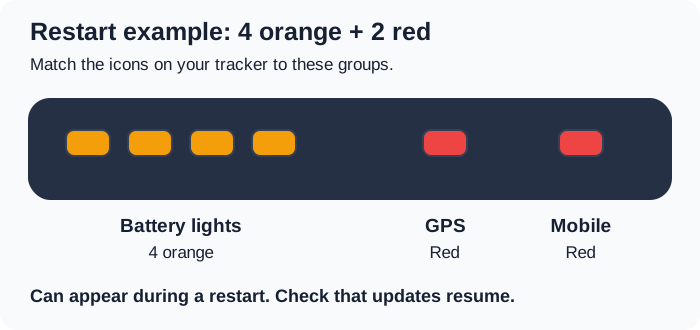
The tracker can restart automatically as well as after a reset. Startup lights may change or run across the battery indicators before the normal status display returns. The exact sequence depends on the hardware, firmware and reason for the restart.
What should I do?
- Let the tracker finish starting and give it a couple of minutes to communicate.
- Check its latest communication or update time in the app or web portal. A recent successful update is more useful than a snapshot of the lights. An old location on the map does not by itself show whether the tracker has just communicated.
- If updates do not resume, check the charge, data plan and mobile coverage. For a GPS test, place it outside with a clear view of the sky.
If the same pattern persists, keeps returning, or the tracker is not communicating, contact support. Include the device ID, when you saw it, whether it was on charge, its last update time, and a short video showing whether the lights are steady or flashing.